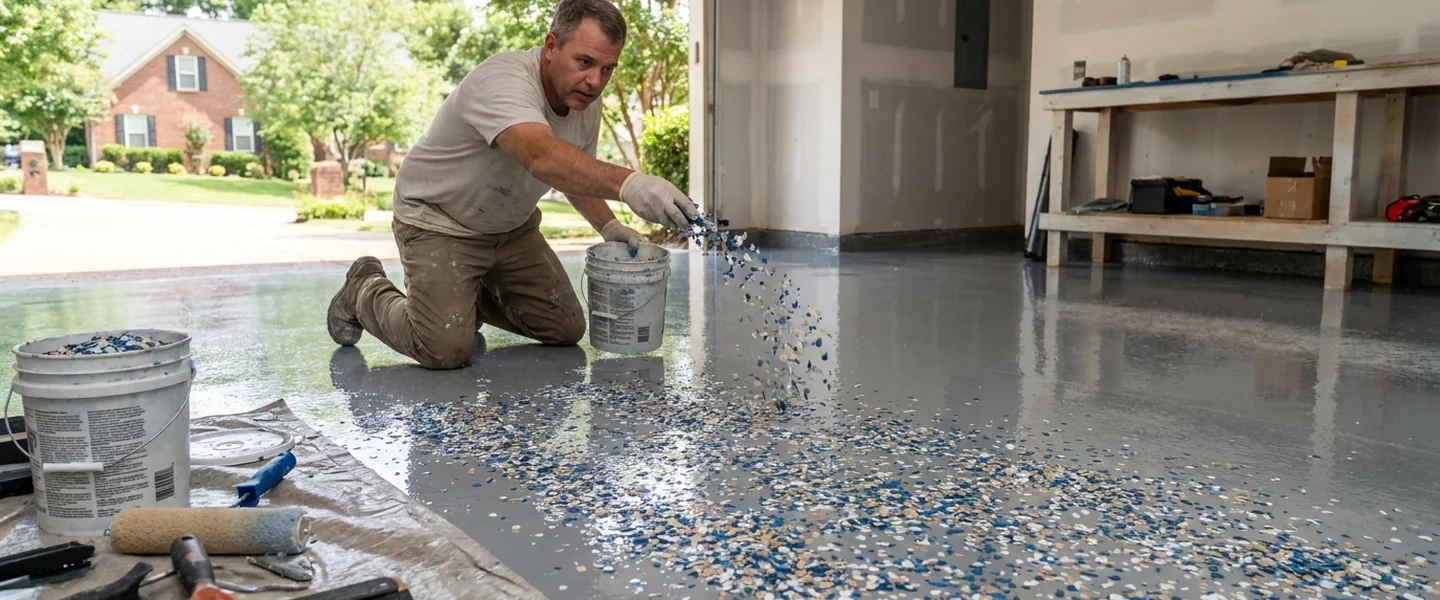
Garage Floor Epoxy Coating in Nashville, TN
Diamond-ground prep. Moisture-tolerant primer. Full flake broadcast. Polyaspartic topcoat rated for hot tires and Tennessee humidity. One free on-site estimate.
Call Now: (615) 395-6130The Nashville Standard for Garage Floor Coating
Nashville Epoxy Floor Pros installs garage floor epoxy coating systems for homeowners across Middle Tennessee — from the upscale garage renovations in Brentwood (37027) to the brand-new tract-home slabs coming out of Murfreesboro (37129) and Spring Hill (37174). We do one thing and do it right: properly prepared, properly primed, and properly coated concrete floors that last.
The difference between a garage floor that holds for fifteen years and one that peels in eighteen months comes down almost entirely to surface preparation. We use industrial-grade diamond grinders — not acid etching — to open the concrete surface profile to a CSP-3 standard. That's the profile epoxy manufacturers require for a structural bond. Acid-etched profiles range from CSP-1 to CSP-2, which is why acid-etched installs show higher delamination rates, especially on Nashville's humid slabs where moisture vapor emission is a real variable.
After grinding, we test moisture vapor emission with a calcium chloride test or relative humidity probe. If the slab is running high MVE — common on new construction in Mount Juliet (37122) and Spring Hill (37174) — we use a moisture-mitigating primer before any coating goes down. No shortcuts, no guessing. Call (615) 395-6130 for your free on-site estimate.
What Garage Floor Epoxy Coating Means in Middle Tennessee
Tennessee summers push garage slab temperatures into the 90s by early afternoon in June, July, and August. That means your floor coating faces one of the harshest residential use environments in the country — hot tires pulling into the garage two or three times a day, seasonal humidity swings from March through October, and occasional freeze events from late November through February that test the bond at the concrete interface.
A system designed for Nashville needs to handle all three. Our standard residential system uses an epoxy base coat for build and bonding, a full flake broadcast in the color blend of your choosing, and a 100% solids polyaspartic topcoat formulated for UV stability and hot-tire resistance. The polyaspartic topcoat does not yellow under Tennessee sun and does not soften under hot tires. It also cleans up with soap and water — motor oil, transmission fluid, and most household chemicals wipe right off without staining.
Project Details
| Standard Garage Size | 400–800 sq ft (two-car), 200–350 sq ft (one-car) |
|---|---|
| Install Timeline | Day 1: diamond grind + primer. Day 2: base coat + flake + topcoat. |
| Cure Time | Light foot traffic: 12–16 hours. Vehicle traffic: 24–48 hours (polyaspartic topcoat) |
| Surface Profile | CSP-3 via diamond grinding (never acid etch) |
| Primer | Moisture-tolerant epoxy primer; vapor-block option for MVE > 8 lbs/1,000 sq ft/24 hrs |
| Flake Color Blends | 40+ options from natural stone to bold solids; custom blends available |
| Topcoat | 100% solids polyaspartic — UV-stable, hot-tire rated, slip-resistant aggregate available |
| Warranty | 15-year product warranty; 5-year workmanship warranty (transferable) |
| Pricing | Quoted per job after free on-site inspection — every quote is itemized in writing |
Our Installation Process
On-Site Inspection + Written Quote
We visit the garage, measure the slab, check for cracks or previous coatings, and test moisture vapor emission. We deliver a written, itemized quote within 24 hours. No surprise add-ons during the job.
Surface Prep — Diamond Grinding
Day 1 begins with a walk-through to clear the floor and mask walls. We run industrial diamond grinders across the entire slab to open the concrete surface profile to CSP-3. Dust is collected with a HEPA-filtered vacuum attachment.
Crack Repair + Patch
Any cracks or divots identified in the inspection are filled with polyurea joint filler or epoxy crack repair compound and allowed to cure before the primer goes down. A cracked slab that isn't repaired before coating will telegraph cracks through the finished system.
Moisture-Tolerant Primer
We roll the epoxy primer in two perpendicular passes to ensure full coverage in the pores opened by grinding. On high-MVE slabs, we use a moisture-mitigating primer that creates a vapor barrier between the concrete and the decorative layers above it.
Base Coat + Flake Broadcast
Day 2 begins with the decorative base coat. We broadcast the vinyl flake chips into the wet base coat until full rejection — meaning flake chips cover every square inch and no base coat shows through. After cure, we scrape and vacuum excess flake.
Polyaspartic Topcoat
The topcoat is rolled in two passes at 90° angles to each other, locking in the flake chips and creating a high-gloss, durable wear surface. If you've requested anti-slip aggregate, it's added to the topcoat at this stage. We leave detailed cure-time instructions before we go.
Materials We Use
| Product | What It Does |
|---|---|
| Penntek industrial epoxy primer | High-solids moisture-tolerant base coat; bonds to CSP-3 diamond-ground concrete |
| Wolverine Coatings broadcast system | Full-reject vinyl flake broadcast in 40+ color blends; 1/4" standard chip |
| PolyTek polyaspartic topcoat | UV-stable, 95% solids, hot-tire rated, 15-year warranty-backed finish coat |
| Citadel vapor-block primer | Moisture-mitigating primer for slabs with MVE above 8 lbs/1,000 sq ft/24 hrs |
Common Scenarios We See in Nashville Garages
Big-Box Store Coating Failures
The most common repair call we get is peeling epoxy paint from a weekend DIY kit. These kits skip diamond grinding, use thin water-based formulas, and carry no real warranty. We grind off the existing coating, reprepare the slab, and install a proper system that bonds and holds.
New Construction — Curing Compounds
Builders spray curing compounds on new pours to slow moisture loss and prevent shrinkage cracking. Those compounds must be fully removed before any coating bonds. On new homes in Smyrna (37167), Spring Hill (37174), and Mount Juliet (37122), we always assume a curing compound is present and grind accordingly.
Oil-Contaminated Slabs
Old garages in Gallatin (37066) and Hendersonville (37075) often have decades of oil and grease embedded in the concrete. Grinding removes the surface layer, but deep oil saturation requires mechanical profiling to reach clean concrete. We detect contamination during the inspection and quote the additional prep time honestly.
High-Moisture Slabs in Basements
Nashville's Cumberland Valley geography means many homes in Hendersonville (37075) and areas near Percy Priest Lake have elevated groundwater tables. Basement garage slabs in these areas often read 12–15 lbs MVE on a calcium chloride test. We use vapor-block primers rated for these conditions.
Why Nashville Homes Need This
Uncoated concrete is porous. Every oil drip, road salt tracked in from I-65 or I-24, and spilled chemical penetrates the surface and degrades the concrete over time. In Nashville's heat, bare concrete also absorbs and radiates heat — stepping into an uncoated garage in July feels like stepping into an oven. A coated floor reflects more light, stays cooler, and is dramatically easier to clean.
There's also a real resale value argument. In Brentwood (37027) and Franklin (37064), where home prices routinely clear the half-million-dollar mark, buyers notice a finished garage floor. Realtors we've spoken to anecdotally say a finished garage is a listing differentiator in these markets — particularly for buyers moving from out-of-state who aren't used to seeing unfinished garages in luxury price brackets.
Warranty in Detail
Our residential garage floor coating systems carry a 15-year product warranty on the polyaspartic topcoat and a 5-year workmanship warranty on the installation labor and bonding.
What's covered: delamination from properly prepared substrate, topcoat cracking under normal residential use, manufacturer defects in material, and failure at the bond line.
What's NOT covered: damage from impact (dropped heavy tools, floor jack edges), chemical spills left more than 24 hours without cleaning, damage from standing water caused by plumbing leaks or flooding unrelated to the coating, and surfaces that weren't disclosed during the inspection (buried oil contamination, previous coatings concealed by rugs, etc.).
Transferability: The 5-year workmanship warranty transfers to the next homeowner with written notice to us within 30 days of closing. Most franchise competitors offer non-transferable warranties — a meaningful difference if you're in a market like Brentwood or Franklin where resale is part of the investment calculus.
How We Quote (Without Quoting on the Phone)
We don't give phone quotes. Not because we're withholding information — because a phone quote is almost always wrong. The variables that determine the actual cost of a garage floor coating are things only visible on-site: slab condition, existing coating, oil or chemical contamination, moisture vapor emission, crack severity, and actual square footage (contractor square footage and actual square footage differ by 10–15% regularly).
A quote built without seeing the slab almost always has a "contingency" baked in that gets revealed as a change order on day one. We'd rather walk your garage for 30 minutes and give you one accurate written number than give you a low estimate over the phone and renegotiate when we show up. Call (615) 395-6130 to schedule your free inspection.
After the Install
First 24–48 hours: No vehicle traffic. Light foot traffic after 12 hours. Keep the garage door down to moderate temperature if it's hot.
First 30 days: Avoid harsh chemical cleaners. Soap and water is fine. Don't slide or drag heavy metal objects across the floor.
12-month follow-up: We reach out at 12 months to inspect the coating under real-world conditions and document it for warranty records. If anything needs a touch-up within the workmanship warranty period, we schedule a return visit at no charge.
Long-term maintenance: Sweep or blow out the garage regularly to prevent abrasive grit from accumulating under vehicle tires. Mop with diluted dish soap when needed. The polyaspartic topcoat does not require waxing or sealing — ever.
Frequently Asked Questions — Garage Floor Epoxy Coating
How long does a garage floor epoxy coating last in Tennessee?
Properly installed polyaspartic-topped systems in Tennessee conditions routinely last 15–20 years with basic maintenance. The limiting factor is almost always prep quality, not material quality. A system installed on a properly ground and primed slab bonds at the crystalline level — it doesn't peel, it wears. Wear-through on a high-traffic garage floor with daily vehicle use typically begins at the 15-year mark on properly installed systems.
Can you coat over an existing epoxy or paint?
Sometimes, but rarely without additional prep. Existing coatings must be mechanically bonded — they can't be loose, peeling, or incompatible with the new system. We test adhesion by grinding a small area and checking the bond. If the existing coating is solid and compatible, we can scuff and recoat. If it's peeling or thick, we grind it off entirely before starting fresh. We identify this during the free on-site inspection.
Is the floor slippery when wet?
A smooth polyaspartic topcoat with no aggregate is somewhat slippery when wet — comparable to polished tile. We add silica or aluminum oxide anti-slip aggregate to all floors in areas likely to see water: near garage doors (rain blowback), laundry areas, and any area with floor drains. You can specify the grit level at the quote stage. We default to a medium grit for most residential installs.
Will hot tires lift the coating?
Not with a polyaspartic topcoat. Budget epoxy paint from hardware stores softens under hot tires because the formulas have low glass transition temperatures — below 90°F in some cases. Our polyaspartic topcoat is rated for hot-tire use at up to 140°F. Nashville summer garage slab temperatures peak in the low-to-mid 90s on hot afternoons, well below the topcoat's threshold.
How do you handle moisture vapor emission?
We test every slab with a calcium chloride kit or a relative humidity probe before quoting. Slabs reading above 8 lbs/1,000 sq ft/24 hrs on calcium chloride — common on new construction in Spring Hill, Mount Juliet, and the newer Murfreesboro subdivisions — receive our vapor-block primer system rather than the standard primer. The vapor-block creates a physical barrier that prevents moisture from migrating upward and breaking the bond between the primer and concrete.
What do I need to do to prepare my garage?
Move all vehicles, storage, shelving, and personal property off the floor before we arrive on Day 1. We handle the rest. If there are heavy items you can't move — water heaters, fixed workbenches — let us know during the inspection and we'll plan the job around them. We mask baseboards and door thresholds before grinding to protect adjacent surfaces.
Do you work in Brentwood, Franklin, and the surrounding areas?
Yes. We serve the entire Greater Nashville area including Brentwood, Franklin, Murfreesboro, Hendersonville, Smyrna, Gallatin, Spring Hill, and Mount Juliet. See our service area pages for more detail on each location.
Can I get a written estimate before committing?
Yes — that's the only kind of estimate we give. We don't quote verbally or over the phone. After the free on-site inspection, you receive a written, line-item estimate within 24 hours. No pressure to sign on the spot. Call (615) 395-6130 to schedule.
Also Serving These Nashville-Area Communities
Read about our work in your area: Brentwood · Franklin · Murfreesboro · Hendersonville · Smyrna · Gallatin · Spring Hill · Mount Juliet
Related reading: How Much Does Epoxy Floor Coating Cost in Nashville? · Polyaspartic vs Epoxy: What Lasts Longer in Nashville?
Schedule Your Free Garage Floor Inspection
Same-week appointments. Written estimate within 24 hours. No pressure.
Call (615) 395-6130 Contact Us Online